 Faith Ringgold (American) b. 1930, The Sunflower Quilting Bee at Arles, 1991Acrylic on canvas, tie dyed, pieced fabric border, 74 x 80 inches, Private Collection
 The Artist- This painting is called "The Sunflower Quilting Bee at Arles" by Faith Ringgold. She was born in 1930 and was born in New York and raised in Harlem. She was also the artist that wrote and illustrated "Tar Beach", one of the seventeen books that she published. She attended the City College of New York. She also has a daughter who is a writer.
The Artwork- This tells of a Quilting Bee that took place in Arles. It was painted on canvas with Acrylic paint. It is tie dyed and has a fabric border. The picture is quite large, being 74 x 80 inches, probably having a big, important meaning to it. There are African-American women all gather around a quilt, and since they are all gathered around the quilt, they must be working on it together. All the women are famous heroes except one. It probably represents them working together to make the world a better place. The scene in the artwork takes place in Arles, France.
The work and Vincent Van Gogh- The single man in the picture is meant to be Vincent Van Gogh. There is many sunflowers in the background of the painting, and Vincent Van Gogh is well known for his sunflower painting. The sunflower painting was completed in 1888, the year he arrived in Arles. The painting "The Sunflower Quilting Bee at Arles" also takes place in Arles, France. There are yellow houses in the background, and one of Vincent Van Gogh's paintings was of a yellow house. That's probably another connection.
Anything Else?- It is owned by a Private Collector, probably making unavailable to public view. I also think that it was made with fabric to represent the quilt in the painting. That is interesting.
Emotionalism
 Pablo Picasso 1881-1973,The Old Guitarist, 1903oil on panel, 123x83cm,Art Institute of Chicago
The Artist- Pablo Diego José Francisco de Paula Juan Nepomuceno María de los Remedios Cipriano de la Santísima Trinidad Martyr Patricio Clito Ruiz y Picasso lived 1881-1973. He was a Spanish painter and was a co-founder of Cubism-styled painting. He lived during the Spanish Civil War.
The painting- The man in the painting is huddled in an awkward position. The Old man was meant to be one of Picasso's friends. What kind of art is this? This is "The Old Guitarist" by Pablo Picasso. I think this is a fine example of emotionalism. The color scheme plays a huge role in presenting the emotion of this painting. I think what the artist of this painting is trying to say is "grief". The facial  expression and the posture of the old man is important too. He painted it in his grief after the death of his friend. The lines are not very emphasized. Color stands out more in this painting. Color and shape play a huge role in this painting.
The color of "The Old Guitarist" is blue. I think that this means the man is melencholy. He is huddled around the guitar like it was his last hope. I think the man is going through some hard times, maybe he is poor.
e a statement.
The women in the painting was discovered at:http://en.wikipedia.org/wiki/The_Old_Guitarist
Anything Else-Could this man be grieving about a woman? Picasso painted this in grief of his friend's suicide death. Do he lose a loved one? There is a woman in the painting if you look closely at the painting. Picasso probably meant to be painting a woman in the first place. It was finished in 1903, during his Blue Period (1901–1904) .
Formalism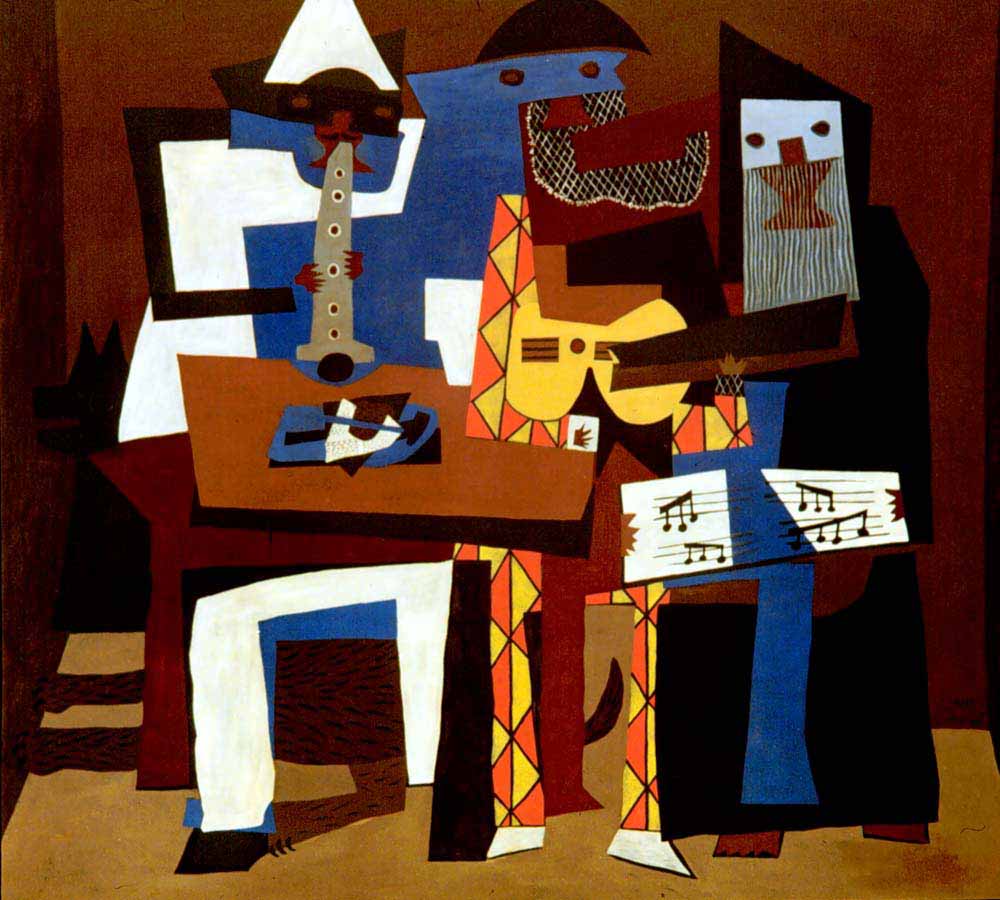 I got this painting from http://ecmc.rochester.edu/rdm/graphics/tm.jpg
Modern and Contemporary Art
Three Musicians
Made in France
1921
Pablo Ruiz y Picasso, Spanish, 1881 - 1973
Oil on canvas
80 1/2 x 74 1/8 inches (204.5 x 188.3 cm)© Estate of Pablo Picasso / Artists Rights Society (ARS), New York
The Artist- When Picasso was 13, his father saw him working on a sketch of a pigeon. His father then gave up art, saying that his son had surpassed him in skill. One of his most famous paintings was Guernica. He painted it during the Spanish Civil War. This is another Picasso's work. It is called "The Three Musicians." I think this is a fine example of synthytic cubism. The picture is meant to be more abstract has more emphasis on shape, line, texture and color than realism. The man in the middle is a harlequin who is playing a guitar, one of the subjects that appeared many times in Picasso's work during the Rose Period(1904–1906), though the painting was finished in 1921. There are two other musicians on either side of him. There is a dog under the table. His ears are seen to the left of the painting. It is very large, being larger than two meters in length and height. It is surprising to me that this painting was painted with oil paint. The painting is so boxyish and abstract that it looks like cut paper. The oil paint makes everything look very solid. The shapes overlapped each other and are very solid colors, probably giving it it's "cut paper" look. ARS, Artists Rights Society is a copyright and monitoring organization for artists from around the world. Pablo Picasso is one of the many artists that are represented by the ARS. ARS also represents Joan Miro. ARS asked Google to removed the decorated versions of the Google Logo that contained parts of Joan Miro's and Salvador Dali's artwork under the ARS's protection. Theodore Feder, the president of ARS said,"there are underlying copyrights to the works of Miró, and they are putting it up without having the rights".
Spanish Culture
 I got this painting from http://arts.anu.edu.au/polsci/courses/POLS1005/2007/Images/Picasso.Guernica2.jpg
Pablo Picasso 1881-1973, Guernica, 1937Medium: oil on canvas Original Size: 11 ft 5 1/2 in x 25 ft 6 inStyle: Cubism Genre: War Location: Museo del Prado, Madrid
The Artist- Pablo Picasso was also a sculptor. He created a huge sculpture call The Chicago Picasso, refusing to be paid $100,000 for donating it to the city. He changed it style very often and many of his paintings were his own interpretations of works by Monet, Goya and other artists.
 The Artwork-This painting is called Guernica by Pablo Picasso. This was painted for the tradgedy of the Nazi bombing of Guernica during the Spanish Civil War. There are many hidden images throughout this painting. For example, there is a bull that is running its horn through the horses torso. The bull's nose is formed by the kneecap of the horse's front leg that is on the ground. The whole bull is formed by the horses entire leg. The bull and horse is has a very important meaning to it as the bull and horse is very important to Spain.
 The year (or years) it was made- The painting was finished in 1937, the year of the Nazi bombing of Guernica. That means that the painting is an Anti-War Statement. Guernica is a small town in Spain. Pablo Picasso was a spanish painter.
Imitationalism

Auguste Renoir French, 1841 - 1919A Girl with a Watering Can, 1876oil on canvas, 100.3 x 73.2 cm (39 1/2 x 28 3/4 in.) Chester Dale Collection1963.10.206
I got this painting fromhttp://www.nga.gov/cgi-bin/pimage?46398+0+0+gg83
Igot the extra info from http://en.wikipedia.org/wiki/Renoir
The Artist- Auguste Renoir is a French painter. He lived from 1841 to 1919. He was took part in the development of French Impressionism. During that time, many people did not like Renoir's style. They found the quick and colorful strokes of Impressionism painting to be very sloppy. And by the time people have come to appreciate the beauty of Imressionism paintings, Renoir had changed the style of his paintings. In Renoirs paintings, many of the figures fused within their surroundings. Later in his life, Renoir developed Arthritis.
The Artwork- Renoir's style of painting also shows in this painting. The artwork was finished in 1876. Rather than blending the colors together, Renoir painted different colors with different strokes to demonstrate value and shadowing. The lines are not very noticable, and the girl"s figure seems to be part of the background rather than the subject of the painting. The colors of the painting is very vibrant. I think this painting is Imitationalism. Though the stokes are not solid, the painting is still very realistic and is not abstract and the painting seems to be sparkling. That is why I think this painting is a fine example of Imitationalism.
Vietnamese Culture

Nguyen Phan Chanh, 1892-1984 Channeling Experience with a Medium, 1931 Silk Painting
I got this painting and Credit line from http://www.asia-art.net/vietnamese_artists1.html
The Artist- Chanh was born to a poor family. He was born in 1892. He recieved a Sino-Vietnamese Education. He recieved a Painting Prize in 1931. Many of his works include women of Rural Vietnam. His daughter is a writer. He introduced silk painting to Vietnam and proved it an appropriate way of painting. He died in 1984.
The Art- This is a silk painting. It may show a family of Vietnamese people at a meal. The man/boy wearing the headband is holding a pair of chopsticks. There appears to be smoke coming from the center of the room. There is women in the painting too. Silk painting has been done for many centuries in Asia. It is done by painting the silk with dye. It is done with water-coloring techniques. I think that the Silk painting was done to represent the normal families of Vietnam. Silk is a favored material in Asia and maybe the material of the painting has a meaning to it.

Other...
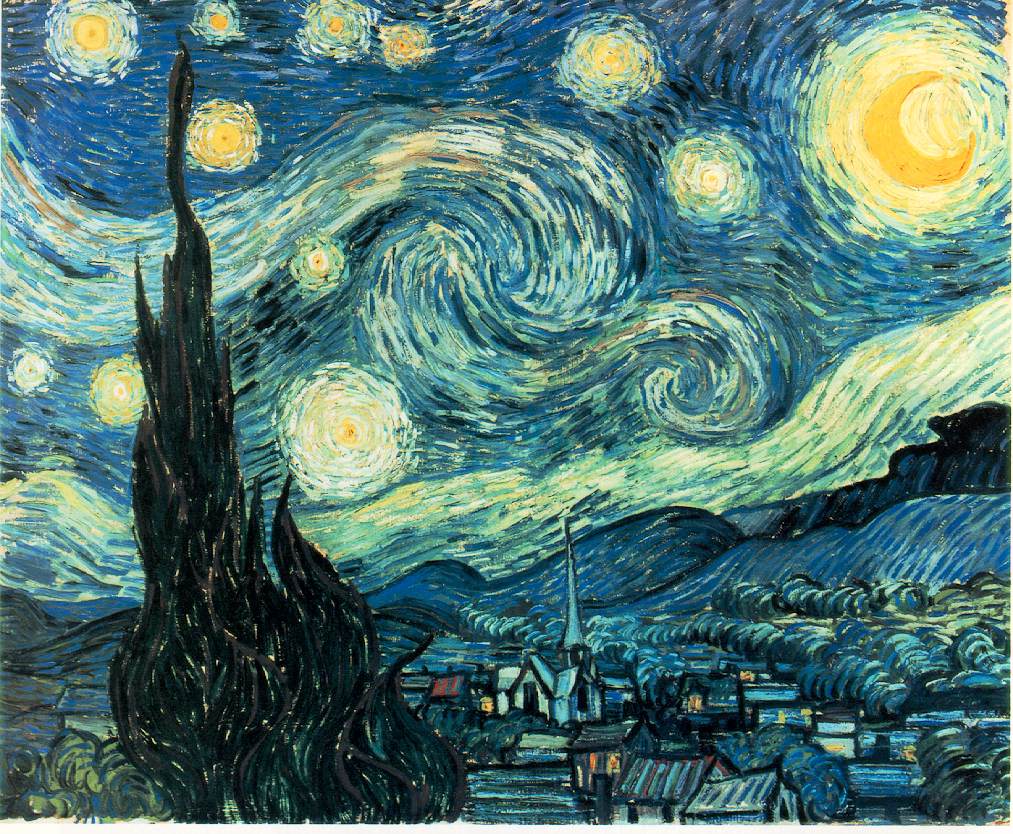 Starry Night, Vincent Van Gogh, 1889Oil on canvas,73 × 92 cm, 28¾ × 36¼ in, Musuem of Modern Art, New York City
This painting is called Starry Night by Vincent Van Gogh. It is a fine example of Impressionism. How does the lines and swirls make this painting unique rather than painting it like this?

Interesting Videos...
Check it out!
"me drawing Marilyn Monroe"-From EclecticAsylumArt at Youtube.com


